expr:class='"loading" + data:blog.mobileClass'>
Showing posts with label Lesson - 6. Show all posts

Thursday, May 7, 2020

The First Sin and God's Redemption Plan, Senior - I, Lesson - 6

SENIOR

AGE GROUP: 14 - 15 YEARS

STANDARD (GRADE): IX & X

Permission is granted only for free distribution among Sunday School children.

No part of this document can be modified, sold or used for any commercial purpose.

LESSON – 6

THE FIRST SIN & GOD’S REDEMPTION PLAN

Click this link to get Senior lessons 1 - 15

The First Sin: 

God created the first man named Adam and a woman named Eve. God told them to subdue the earth and gave them authority over other living beings on earth. Adam and Eve were placed in a beautiful garden called Eden. Every fruit in the garden was provided for their food except the fruit from the “tree of the knowledge of good and evil”. God told them that they would certainly die, if they eat its fruit. One day, a serpent (Refer Revelations 12:9) spoke to Eve and convinced the woman that God was preventing her from eating the fruit of the tree of the knowledge of good and evil because he did not want their eyes to be opened. Through Satan’s prompting, Eve ate the fruit of that forbidden tree and gave to Adam also. Their eyes were opened, and realised that they were naked. They lost their child-like innocence and felt ashamed. They sewed fig leaves together and made a dress for themselves.  

Did Adam and Eve die when they eat the fruit?
Even though, God had warned Adam and Eve that they would die, if they eat the forbidden fruit, from the Holy Bible we know that they did not immediately die physically the moment they ate the fruit, but lived for many years afterward. Even though Adam and Eve did not physically die that day, there were other ways in which Adam and Eve died. The Bible lists three types of death. 

                1. Physical death – This happens when the body dies.

                2. Spiritual death - The spirit which illuminates the human soul about the things of God dies within him, so the person becomes dead in his spirit and separated from God. 

                3. Eternal death - Permanent banishment / separation of humanity from God (This is the permanent separation from God after the final Judgement on the last day).

Adam and Eve did die when they ate the forbidden fruit, but their death was spiritual, not physical. Any kind of death causes separation. The death that Adam and Eve experienced when they ate the forbidden fruit was a spiritual death which caused immediate separation from God. They also experienced physical death for their disobedient act. Though it was not immediate, it still was a result from their disobedience of God. The death process began to activate in their bodies, which eventually led to their physical death also. 

Sin separates man from God:
When they heard the sound of the Lord God walking in the garden in the cool of the day, Adam and Eve hid themselves. God asked Adam, "Why are you afraid to meet me? Have you eaten the fruit of the tree of which I told you that you must not touch it?" Instead of accepting their mistake, they blamed each other. God cursed all the three of them (Serpent, Eve and Adam).

Eve’s curse: 
Eve received curses for doubting and disobeying God. Her main curse was Labor pain. Labor pain was a part of Eve’s curse, and for all women who follow in childbirth. Child-bearing, the means of her deliverance(to understand this please read I Timothy 2:11-15), would be a painful event. Another curse was to be ruled over by her husband. 

Adam’s curse: 
Adam too received curses for his role in disobeying God's law. The ground was cursed because of him. Thorns and thistles would grow in the land and he would have to survive by sweating and toiling in the land. The next curse was that he would ultimately return to the ground. As he had come from the dust, in death he would return to the dust. 

Serpent’s curse: 
God cursed the serpent that, all the days of his life, he would eat dust and crawl on his belly. God said he would put enmity between the woman's seed and the serpent’s seed. The woman’s seed will crush the serpent’s head. 

The curses included not only Adam, Eve, and the serpent but also the future generation.  

The Redemption Plan:
However God knew the occurrence of these events through his foreknowledge, and knew of the sin and the suffering it would bring. Hence God had prepared a salvation plan for mankind before the foundation of the world (Ephesians 1:4-10; I Peter 1:19,20). God gave a hint of it when he uttered the curse on the serpent saying that He would put enmity between the woman and the serpent and the woman’s seed would crush the serpent’s head. To fulfill this eternal plan, God the Son, incarnated as a human being and was born into this world as the seed of a woman. The infinite eternal God of the universe became a man of flesh and blood. He was named Jesus. “Jesus” is the English translation of the Hebrew word “Yehoshua” which means “Yah Saves” or “Jehovah Saves”.  He lived in this world without sin, died on the cross and rose again on the third day. Jesus gave his life as an atonement for sin and overcame the curse and death which satan had brought on mankind. 

Footnotes:

Foreknowledge:

One of the important divine attributes of God is His omniscience, which means all-knowing. Because God is all-knowing, God knows what is going to happen in the future also. God knows and sees everything in advance and His will is carried out in accord with His plans and purposes. In the Old Testament God's foreknowledge is usually represented by the verb “yada”, which is the normal verb for "know." In the New Testament the main verbs are proginosko "to know in advance," and proorao, "to see what is ahead". (1) Then a question arises if God can see the future, why God doesn’t stop evil from happening? To understand this, we have to understand God’s unchanging divine attributes such as His righteousness. God has given man free-will, and when man chose to sin, it was against God’s righteousness to snatch him away from his master, the satan. That’s why He gave His son, Jesus Christ as the price to purchase man back. Through His foreknowledge when God saw man sinning, he ordained Jesus as the Lamb to be sacrificed before the foundation of this world (I Peter 1:19,20; Revelation 13:8) though the announcement of the Messiah was done after man sinned.

There are many Bible verses which tell us about the foreknowledge of God

Psalm 139:4 – For there is not a word on my tongue, But behold, O Lord, You know it altogether.

Psalm 139:16 – Your eyes saw my substance, being yet unformed. And in Your book they all were written, The days fashioned for me, When as yet there were none of them.

I Peter 1:1,2 - Peter, an apostle of Jesus Christ, To the pilgrims of the Dispersion in Pontus, Galatia, Cappadocia, Asia, and Bithynia, elect according to the foreknowledge of God the Father,

I Peter 1:20 – He indeed was foreordained before the foundation of the world, but was manifest in these last times for you.

Acts 2:23 – Him, being delivered by the determined purpose and foreknowledge of God, you have taken by lawless hands, have crucified, and put to death

Reference:

1.      Baker's Evangelical Dictionary of Biblical Theology. Edited by Walter A. Elwell Copyright © 1996 by Walter A. Elwell. Published by Baker Books, a division of Baker Book House Company, Grand Rapids, Michigan USA

2.     Holy Bible Reference – Unless otherwise specified all the Scripture references are taken from NKJV.

Bible Reference: Genesis 3

Memory Verse: For if by the one man’s offense death reigned through the one, much more those who receive abundance of grace and of the gift of righteousness will reign in life through the One, Jesus Christ (Romans 5:17 NKJV) 

 Click this link to learn how to organize VBS / Retreats

ASSESSMENT ACTIVITY

I.      Fill in the Blanks:

1. The …………………………………. is the Permanent banishment or separation of humanity from God.

2. The death that Adam and Eve experienced when they ate the forbidden fruit was a …………………………… .

3. The curse for Adam was, “As he had come from the dust, in death he would return to the ……………………”. 

4. “…………………….” is the English translation of the Hebrew word which means “Jehovah Saves”.


II.  Give short answers

1. What had God told Adam and Eve would happen if they eat the fruit?


2. What happened when Adam and Eve ate the fruit?


3. What was the death experienced by Adam and Eve when they ate the fruit?


4. What was God’s redemption plan?


III.          Give brief answers

1. What were the curses received by Adam, Eve and the serpent?


Moses, the son of Pharaoh's Daughter, Intermediate - I, Lesson - 6

INTERMEDIATE

AGE: 12 - 13 YEARS

STANDARD/GRADE: VII & VIII

Permission is granted only for free distribution among Sunday School children.

No part of this document can be modified, sold or used for any commercial purpose.

LESSON – 6

MOSES, THE SON OF PHARAOH’S DAUGHTER

After the death of Joseph, the new Pharaoh who ruled over Egypt did not know about the contributions of Joseph. The Pharaoh felt insecure because of the growth of the Israelites and he wanted to control them through oppression. He forced the Israelites into slavery and made them to do hard labour by building royal store cities. He also ordered the Israelite boy babies be thrown in the Nile River. It was during this time that Moses was born as the son of Amram and Jochebed, an Israelite couple from the priestly tribe of Levi. Moses’ mother cared for him for three months, after that she could not hide him. So, she made a basket out of reeds covered it with pitch to be water-proof, placed the baby in the basket and set it in the Nile River.

Moses saved from the Nile River

The daughter of Pharaoh came down to bathe at the Nile. She saw the basket among the reeds. When she opened it, she saw the child crying and she had pity on him and said, ‘This is one of the Hebrews children’. Miriam, the child’s sister asked the Princess whether she could bring a Hebrew woman to nurse the child for her. Pharaoh’s daughter agreed. The girl brought the child’s mother. Pharaoh’s daughter told her to take the child and nurse him for her. She even promised to give her wages for nursing Moses.

Moses, the son of Pharaoh’s daughter

Moses was given an opportunity which many other boy babies of his day didn’t get. When the other Israelite boy babies were thrown into the Nile River and were eaten by the crocodiles, Moses was given a chance to live. Not only that, he was given an opportunity to be brought up as a Prince of the most powerful kingdom of the ancient world, the Kingdom of Egypt. So, for forty years he lived in luxury in the Egyptian Palace and was given the best of Egyptian education and he became mighty in words and deeds.

Moses at Midian

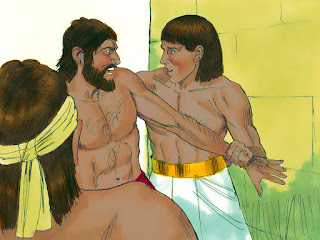
But Moses knew that he was an Israelite and his people were living as slaves in Egypt. When he grew up (40 years of age), he went to see his people and he found them working very hard as slaves. He also saw an Egyptian man ill-treating a Hebrew slave. He couldn’t tolerate it and he killed the Egyptian. Moses was found out and the Pharaoh wanted to kill him. Moses ran away to Midian. There Moses met the seven daughters of a priest of Midian by a well. He was invited to their home and lived there for 40 years as a shepherd.

Moses and the burning bush

Once while Moses was tending to his father-in-law’s flock at Mount Horeb, Moses heard God calling him from a “flame of fire from the midst of a bush”. God told Moses that He had heard the cries of His people and He wanted Moses to deliver them from the Egyptians. God promised to bring them into a Promised Land flowing with milk and honey. But Moses questioned God as to whether He had chosen the right man for the job. He proceeded to tell the Lord that he is not eloquent enough, and that he is too slow of speech and tongue. God told Moses to take his brother Aaron along with him, so that Moses could convey God’s message to Aaron, and Aaron could speak to the Pharaoh.

Moses delivers Israel

Moses was 80 years old and his brother Aaron was 83 when they went to Egypt to rescue their people from the Pharaoh. When Moses and Aaron approached the Pharaoh and told him to let the Israelites go. The Pharaoh refused. God released a full set of 10 powerful judgments against the Egyptians and their gods. The ten plagues were 1. Water turned into Blood 2. Frogs 3. Lice 4. Flies 5. Pestilence on the Livestock 6. Boils 7. Hail 8. Locusts 9.  Darkness 10. Death of All the Firstborn. God told the Israelites to observe a Passover on the day of the last plague, so that the firstborns of the Israelites will be spared the judgement, God was going to bring on the Egyptians. The Israelites did just as God told them and were saved. The Bible says that there was loud crying in Egypt for there was not a household without someone dead. During the night, Pharaoh summoned Moses and told him to leave Egypt.  

Moses leads the Israelites

After the Israelites left Egypt, the Israelites had to cross the red sea. God miraculously made the red sea to part and the Israelites walked in the dry ground in the middle. Moses led Israelites for 40 years through the harsh desert. God gave them a special food called manna from heaven and made water to gush out from a rock. God also did many miracles when they passed through the desert. Moses was unlike any other leader.

Moses, the Greatest Leader

Moses rejected the prestige and the honor and everything that came with being a called as the son of Pharaoh’s daughter. He threw it all away and identified with the Israelite slaves because they were God’s chosen people and God had a plan for them. God rewarded his decision by giving him many rare privileges which very few men have ever received. He was named as the greatest prophet the world had ever seen who saw God face to face (Deuteronomy 34:10-12). Moses spoke with God directly like a friend not through visions or dreams. He saw the glory of God on Mount Sinai and received the tablets of the Ten Commandments written by God himself. He taught the Israelites the law of God, which are called as the “Law of Moses" even today. Moses died at 120 years of age and he was given the honor of being the only human who was buried by God after his death.

In your life when you have to make decisions, can you forsake worldly pleasures and privileges because of your belief? Will you be ready to choose suffering for the sake of God? Will you be ready to take decision that would have impact on your eternity?

Bible Reference: Exodus 1-12; Acts 7:18-36; Hebrews 11:23-29

Memory Verse: By faith Moses, when he became of age, refused to be called the son of Pharaoh’s daughter………….. in Egypt; for he looked to the reward. (Hebrews 11: 24-26).


ASSESSMENT ACTIVITIES

Fill in the blanks:

1. Moses’ mother was given ………………… for nursing him.

2. Moses was tending flocks at Mount …….………… when he heard God calling him from the burning bush.

3. Moses was …………………… years old when he went to Egypt to rescue the Israelites from the Pharaoh.

4. Moses taught the Israelites the law of God, which are called as …………….. 

Give short answers:

1. How was Moses saved from the Nile River? 

2. Why did the Pharaoh want to kill Moses? 

3. What did God tell Moses from the burning bush? 

4. Why did God ask the Israelites to observe the passover? 

Answer in brief:

1. Why is Moses considered the greatest leader and prophet of Israel?


Friday, May 1, 2020

Laban and Jacob, Junior - I, Lesson - 6

JUNIOR

AGE: 10 - 11 YEARS

STANDARD/GRADE: V & VI

Permission is granted only for free distribution among Sunday School children.

No part of this document can be modified, sold or used for any commercial purpose.

LESSON – 6

LABAN AND JACOB


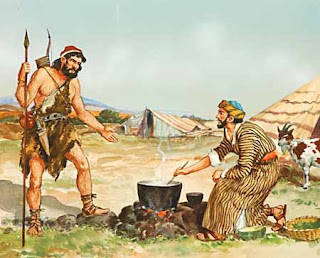
Isaac, the son of Abraham and his wife Rebekah had twin sons named Jacob and Esau. Something interesting happened when Rebekah gave birth to the twins. Jacob was born holding Esau’s heels. That’s why he was named Jacob which meant “heel catcher or supplanter”. Esau was reddish with his body covered with hair, while Jacob was smooth-skinned. Esau was a skilled hunter but Jacob was a tent dweller.


As the firstborn son of Isaac, Esau was given the birthright but Jacob made Esau sell that for a pot of stew. Later Jacob cheated his father and received Esau’s other blessings also. This made Esau furious and he wanted to kill Jacob. Jacob ran away from his brother and went to a place called Haran, where his mother’s brother Laban lived. 

Laban had two daughters, Leah and Rachel. Leah was the oldest and Rachel was the youngest. Rachel was very beautiful.  Jacob told Laban that he would work for him for seven years if he could marry Rachel. Laban agreed. For seven years Jacob took care of Laban’s flock. After the seven years, Jacob asked to marry Rachel. But Laban tricked Jacob and got him married to Leah. Jacob was very angry. Laban said, “It is not our custom to let the younger daughter get married before the older one”.  Laban told Jacob that he could marry Rachel too, but he had to work for seven more years. Jacob, the supplanter whose cheating forced him to leave his father’s home was now tricked by his uncle. This happened thousands of years ago when it was common for a man to have more than one wife. Jacob married Rachel also. 

st-takla.org

Jacob had 12 sons and a daughter named Dinah. He had to work hard to earn wealth for his family. Laban agreed to give Jacob all the striped and spotted sheep and goats as wages for his work. Soon Laban found that the number of striped and spotted sheep in his flock were increasing. Laban decided to change Jacob’s pay. He changed Jacob’s pay ten times. God was building a character of integrity in Jacob and dealt with his serious flaw of deceit in usurping his brother Esau’s blessings through Laban’s dealings with him.  God helped Jacob however, and Jacob’s wealth increased even though Laban tried to cheat Jacob.

Sweet Publishing / FreeBibleimages.org.

After twenty years of working for Laban, Jacob decided to return to his father. Laban's sons were complaining that Jacob became rich with their father's wealth and there was increasing strain with Laban also. Once when Laban had gone to another city to shear the sheep, Jacob took his wives, children, servants and flocks and left Haran unannounced, since Jacob feared that Laban would not let them leave. (Shearing is the process of cutting / shaving the wool off the sheep. This wool would be used to make woollen clothes, blankets etc.). When they were leaving, Rachel stole her father's idols. 

Shearing of sheep

On the third day, Laban was told that Jacob had left Haran, so he followed Jacob. In the night, God appeared to Laban and warned him not to say anything to Jacob, either good or bad. When Laban found Jacob, he accused him of stealing his idols. Jacob got angry with Laban and told him to search all the tents. Rachel took the idols, hid it under a saddle and sat on it. Laban couldn’t find his idol.
Idols that were worshipped during the time of the Patriarchs. The idols that were stolen by Rachel from Laban would have been similar to these. The Bible Lands Museum, Israel

Laban called for a peace covenant between them. Jacob and Laban made a peace treaty between them not to harm each other. That place was called Mizpah. After that Laban went on his way and Jacob continued his journey back home. 

st-takla.org

After many years, Jacob went to a place called Bethel to build an altar to worship God. But before they started their journey to Bethel, Jacob told his family members to throw away all the idols and buried them under an oak tree.

God changed Jacob’s nature during his sojourn in Haran through his dealings with Laban. Even though, Jacob had a lot to complain because of his constant struggle with Laban, God had other plans - to change his nature and to bless him. Jacob came empty-handed to Haran but left with a family of his own, many children who would later become the 12 tribes of Israel and great wealth and his relationship with his brother Esau was also restored.


Bible Reference: Genesis 29 - 31

Memory Verse: Do not be deceived: God cannot be mocked. A man reaps to please the Spirit, from the Spirit will reap eternal life (Galatians 6: 7, 8)


ASSESSMENT ACTIVITIES

Fill in the blanks:

1. Jacob told Laban that he would work for him for ................. years if he could marry Rachel. 

2. Laban changed Jacob’s pay .................. times

3. Jacob and Laban made a peace treaty at a place called .........................

4. The name “Jacob” meant “.......................................”

Give short answers:

1. Why did Esau want to kill Jacob?


2. Why did Laban change Jacob’s pay?


3. Why did Jacob want to return home to his father?


4. What did Jacob do when Laban went to shear the sheep?


Answer in brief:

1. What did Laban do when he found that Jacob had fled Haran?


Moses at Midian, Sub-junior - I, Lesson - 6

SUB-JUNIOR

AGE: 8 - 9 YEARS

STANDARD/GRADE: III & IV

Permission is granted only for free distribution among Sunday School children.

No part of this document can be modified, sold or used for any commercial purpose.

LESSON – 6

MOSES AT MIDIAN

Moses was an Israelite baby boy who was kept by the side of the Nile river in a basket by his mother because of a cruel Pharaoh's order. Moses was found by an Egyptian Princess and was brought to the Egyptian palace. Moses was brought up as an Egyptian prince and was given the best of education in the Egyptian palace. But Moses knew that he was an Israelite and his people were living as slaves in Egypt. 

Sweet Publishing / FreeBibleimages.org.

When Moses grew up, he wanted to see how his people were faring. He found them working very hard as slaves. He also saw an Egyptian man hitting a Hebrew slave. Moses got furious; He looked around and didn’t see anyone. He killed the Egyptian and hid his body in the sand. 

Sweet Publishing / FreeBibleimages.org.

The next day Moses went out again. He saw two Hebrew men fighting. He asked the one who had started the fight “Why are you hitting another Hebrew man?”  The man said, “Who made you ruler and judge over us? Are you thinking about killing me as you killed the Egyptian?” 

Sweet Publishing / FreeBibleimages.org.

Moses became afraid that people had come to know about what he had done the previous day. When Pharaoh heard about what had happened, he tried to kill Moses. Moses escaped from Pharaoh and went to a place called Midian. At Midian, he stopped to rest by a well.

Sweet Publishing / FreeBibleimages.org.

During that time, seven daughters of a priest of Midian came to the well to draw water and fill the troughs to water their father’s flock. When they were doing that some shepherds came there and drove them away, but Moses came to their rescue and watered their flock. 

Sweet Publishing / FreeBibleimages.org.

When the girls returned to Reuel their father, he wondered how they could return so early. They answered that an Egyptian had rescued them from the shepherds. He had even drawn water for them and watered the flock. Reuel asked his daughters why they had not invited him home to have something to eat. 

Sweet Publishing / FreeBibleimages.org.

Moses went to the priest’s home and lived there. Even though, Moses had to run away to a strange country because of his situation, God had arranged for a family to provide for him and care for his needs. For 40 years, he lived the quiet but hard life of a shepherd in Midian. But those were not wasted years. God was training Moses for a great job in the future. 

Sweet Publishing / FreeBibleimages.org.

Bible Reference: Exodus 2

Memory verse: This Moses whom they rejected, saying, 'Who made you a ruler and a judge?' is the one God sent to be a ruler and a deliverer by the hand of the Angel who appeared to him in the bush (Acts 7:35 NKJV). 


ASSESSMENT ACTIVITIES

Answer the following questions:

1. Who lived as slaves in Egypt? ………………………….

2. Why did Moses kill the Egyptian?

    ......................................................

3. What was the name of the priest of Midian? ………………..

4. Who drove the seven daughters of the priest away?

    .......................................................

5. How many years did Moses live as a shepherd in

    Midian?    ....................................................... 

Fill in the blanks:

1. Moses was a Hebrew child who was brought up by an .................... Princess.

2. Moses escaped from Pharaoh and went to a place called ............

3. At Midian, Moses stopped to rest by a ................

4. ................ came to the rescue of the seven daughters of Reuel and watered their flock.

5. For 40 years, Moses lived the quiet but hard life of a ...................