expr:class='"loading" + data:blog.mobileClass'>
Showing posts with label Lesson - 3. Show all posts

Monday, April 6, 2020

Trinity Heresies & The Christian Creeds, Senior - I, Lesson -3

SENIOR

AGE GROUP: 14 - 15 YEARS

STANDARD (GRADE): IX & X

Permission is granted only for free distribution among Sunday School children.

No part of this document can be modified, sold or used for any commercial purpose.

LESSON – 3

TRINITY HERESIES & THE CHRISTIAN CREEDS

Click this link to get Senior lessons 1 - 15
Click this link to get this lesson in Tamil language

Trinity Heresies:

A “heresy” is a belief or opinion contrary to strictly held orthodox religious doctrine. There are many heresies on the doctrine of Trinity which is contrary to what is taught in the word of God. (Click here to learn more about the Holy Trinity)


Modalism (i.e. Sabellianism, Noetianism and Patripassianism) – According to this teaching the same God reveals himself through three different modes. God was the Father in creation, he became son and came to the earth as Jesus, then he turned into the Holy Spirit and sanctifies us. According to modelists, Father, Son and the Holy Spirit never exist together and they exist independently in different eras. This is the belief of Oneness Pentecostals. 

Tritheism ...Tri - theism means three distinct and separate gods. Trinity is confused with Tri-theism mainly because of inadequate understanding of Trinity. Trinity is explained as three persons -Father, Son and the Holy Spirit in one Godhead (Refer to previous lesson). People confuse “Holy Trinity” with Tritheism because of the misunderstanding of the word “persons”. In speaking of the Trinity, the term “person” is not used in the same way it is normally used in human beings. Normally in humans, it means different individuals with separate body, soul and spirit. But in the Godhead, the three Persons are inseparable, and they eternally co-exist as one Divine Being. Some have opted for the term "subsistence". But the term “persons” is used for want of a better term). Muslims usually fault Christians of being tritheistic because of their lack of understanding of Trinity.

Arianism ...taught that Christ was a creation of God and He was not God. Arianism was rejected and the controversy was addressed in the Nicene Creed.

Ebionitism ...taught that while Jesus was completely a human being, he was different from other humans because he was gifted with special charismatic skills and abilities. 

Macedonianism ...taught that the Holy Spirit was a being created by God. 

Adoptionism ...taught that Jesus was a normal human being, but later he was “adopted” by Father God in a special divine way. This might have occurred during any of the special instances of Jesus’ life such as his baptism or resurrection.

Partialism ...taught that Father, Son and Holy Spirit are components of one Godhead. Each of the persons is not fully divine or fully God. (1)

Subordinationism.... it is primarily the teaching that the Son doesn’t exist eternally and he is also not divine and is, therefore, not equal to the Father in his nature or divine attributes and is inferior to Father God.


The First Council of Nicaea:
The First Council of Nicaea was a council of Christian bishops convened in Nicaea (present day Iznik, Turkey in Bithynia) by the Roman Emperor Constantine I in AD 325. It was the first ecumenical council of the Christian Church. The word ecumenical is derived from the Greek word “oikoumenÄ“ "meaning “the inhabited earth". Thus ecumenical means "worldwide". Constantine had invited all 1,800 bishops of the Christian church (about 1,000 in the east and 800 in the west). The participating bishops were given free travel to and from their episcopal sees to the council, as well as lodging.
Council of Nicaea (325 AD), depicted in a Byzantine fresco in the basilica of St. Nicholas in Demre, Turkey

Historians including Jerome and Dionysius have recorded that more than 300 bishops including Bishop John, who was the bishop of India and Persia also attended the first council of Nicaea. It was presided by Hosius of Corduba, who was the bishop of Rome.

This first ecumenical council was the first effort to attain consensus in the church through an assembly representing all of Christendom. One of its main accomplishments was settlement of the Christological issue of the nature of the Son of God and his relationship to God the Father. Most significantly, it resulted in the first uniform Christian doctrine, called the Nicene Creed. (2)

Memory Verse: For everyone born of God overcomes the world. This is the victory that has overcome the world, even our faith. Who is it that overcomes the world? Only the one who believes that Jesus is the Son of God. This is the one who came by water and blood—Jesus Christ. He did not come by water only, but by water and blood. And it is the Spirit who testifies, because the Spirit is the truth. (I John 5:4-6 NKJV)

NICENE CREED

The Creed is a profession of faith, a declaration and summary of the Christian faith widely used in Christian liturgy. It is called Nicene Creed because it was originally adopted in the city of Nicaea during the first Christian council.

WE BELIEVE in one God, the Father, the Almighty, maker of heaven and earth, of all that is, seen and unseen.

We believe in one Lord, Jesus Christ, the only Son of God, eternally begotten of the Father, God from God, Light from Light, true God from true God, begotten, not made, of one Being with the Father. Through him all things were made. For us and for our salvation he came down from heaven: by the power of the Holy Spirit he became incarnate from the Virgin Mary, and was made man. For our sake he was crucified under Pontius Pilate; he suffered death and was buried.
On the third day he rose again in accordance with the Scriptures he ascended into heaven and is seated at the right hand of the Father. He will come again in glory to judge the living and the dead, and his kingdom will have no end.

We believe in the Holy Spirit, the Lord, the giver of life, who proceeds from the Father and the Son. With the Father and the Son he is worshiped and glorified.
He has spoken through the Prophets. 

We believe in one holy catholic and apostolic Church.
We acknowledge one baptism for the forgiveness of sins.
We look for the resurrection of the dead, and the life of the world to come. 
Amen. (3)                                              

(Note: Catholic means universal) 

The oldest manuscript of the Nicene creed, dated to the 6th century, 
Picture credit: Public Domain

APOSTLES’ CREED

This is the oldest creed; it was used by Christians in the First century Church. 

I believe in God the Father Almighty, creator of heaven and earth, 

And in Jesus Christ, God's only Son, our Lord, who was conceived by the Holy Spirit, born of the Virgin Mary, suffered under Pontius Pilate, was crucified, died, and was buried; he descended to the dead. On the third day he rose again; he ascended into heaven, he is seated at the right hand of the Father, and he will come to judge the living and the dead. 

I believe in the Holy Spirit, the holy catholic Church, the communion of saints, the forgiveness of sins, the resurrection of the body, and the life everlasting. Amen. (4) 

Reference:

(1)            HaNaviy A. B. (2019 December 7).  Exploring the Shema (Paper Two): YHVH and Yeshua. (Retrieved 9th August 2020 from http://www.tetzetorah.com/exploring-the-shema)

(2)           First council of Nicaea (Retrieved 9th August 2020 from  https://www.newworldencyclopedia.org/entry/First_Council_of_Nicaea)

(3)           Nicene Creed (Retrieved 9th August 2020 from http://www.tsm.edu/the_three_creeds/)

(4)           Apostles’ Creed (Retrieved 9th August 2020 from http://www.tsm.edu/the_three_creeds/)


 ASSESSMENT ACTIVITY

I.      Fill in the Blanks:

1. The ……………….. controversy was addressed in the Nicene Creed.

2. …………………….taught that while Jesus was a human being, he was gifted with particular charismatic skills and abilities.

3. Bishop ………………….., was the bishop of India and Persia also attended the first council of Nicaea.

4. One of the main accomplishments of the First Council was the settlement of the ……………………… issue of the nature of the Son of God.

II.     Give short answers:

1. What is a heresy?


2. What is the modalist teaching?


3. What is tritheism ?


4. What is macedonianism?


III. Give brief answers:

1. Write briefly about the “First Council of Nicaea.” 


Sunday, April 5, 2020

Abraham's Journey, Intermediate - I, Lesson - 3

INTERMEDIATE

AGE: 12 - 13 YEARS

STANDARD/GRADE: VII & VIII

Permission is granted only for free distribution among Sunday School children.

No part of this document can be modified, sold or used for any commercial purpose.

LESSON – 3

ABRAHAM’S JOURNEY

To give a brief background for today’s lesson, let us recap some of the important incidents from the beginning, given in the book of Genesis. God created the universe, then He made Adam and Eve in His own image, Adam and Eve lose eternal life because of sin, God’s redemption plan or salvation plan for mankind, that would be achieved through the arrival of a Messiah or a Saviour as a woman’s seed. 

God’s Plan and Satan’s Corruption

Satan wanted to stop the salvation plan of God, so he corrupted the people to be wicked so that God would destroy them. It almost happened once when God destroyed the earth with flood because of people’s wickedness, but there was a righteous man named Noah, through whom a godly generation continued. By the time it reached the tenth generation of Noah, i.e. the generation of Abraham, people had entirely forgotten their creator and they made their own gods to worship them. But God found Abraham to be faithful, and he revealed Himself to Him. 

The Patriarchs

Abraham was one of the important men chosen by God to work out His redemption plan. Abraham is considered as one of the main "Biblical Patriarchs". The patriarchs of the Bible, are Abraham, his son Isaac, and Isaac's son Jacob, also named Israel, the ancestor of the Israelites. These three ancestors of Israel are referred to collectively as the patriarchs, and the period in which they lived is known as the patriarchal age. 

The Call of Abraham

Before God called Abraham, he lived in a place called Ur and did not worship the one true God of Israel. God revealed Himself to Abraham and told him to leave his country and his own people and to embark on a journey to the nation where He would show Him. The ultimate purpose of God calling Abraham out of his own people, was to create a holy nation out of his descendants, through whom the Messiah could be born. For a Saviour to be born, there had to be a holy generation. God chose the descendants of Abraham, the Israelites as a holy nation and gave them special laws including the ten commandments and various other laws to teach them how to lead a holy life. When God told Abraham to leave his nation and to go to the place shown by Him, Abraham immediately obeyed and started the journey. In this lesson we are going to learn about Abraham and his “journey of faith”. 

Abraham - The Father of Faith 

The journey which Abraham made was a journey of faith, since Abraham had to

·         Leave the country of his ancestors, abandon his familiar surroundings that gave him his identity and security.

·         Start off on a trip with no map, no destination and not knowing where he was going, travelling by foot and camel-back rides.

·         Didn’t know what to expect on the journey - whether he would be travelling through desert, plains or hills, what dangers await him, whether food was available...

Abraham travelled approximately 950 miles to Canaan, during a time when no modern gadgets, technology or transport was available. Abraham had so much faith in God that he was willing to risk everything. Abraham’s life is an example for the explanation for faith given in Hebrews 11:1, Faith is the substance of things hoped for, the evidence of things not seen. That’s why Abraham is called the “Father of Faith”. 

Landmarks

While travelling from his native country to the promised land, Abraham made short stops in many places which are recorded in the Book of Genesis. Even though thousands of years have passed since Abraham made that journey, proof for the existence for those places have been obtained through archaeology. Each of these places are considered significant in understanding the history of the nation of Israel. (Abraham was known as Abram before God changed his name, but for convenience sake, the name Abraham is used while discussing all the landmarks below). Some of the landmark halting places of Abraham are listed below 

1. Ur of the Chaldees (modern day Iraq), was the birthplace of Abraham. It was the capital city of the famous olden Chaldean Empire in the region of Mesopotamia. The Lord appeared to Abraham and told him to leave his native country, his own tribe and to go to a land that He would show him. He submitted to the voice of God and left Ur with his family including his father Terah, wife Sarai and his nephew Lot (Gen. 11:31).

Ruins of "Ur of the Chaldees or Ur Kasdim" in modern day Iraq

2. Haran in Mesopotamia – This is the first halting place of Abraham mentioned in the Book of Genesis. He left this place after his father Terah died (Gen. 11:31 -12:4). 

Harran in present day Turkey

3. Shechem was the first place where Abraham encountered Canaanites. The Lord appeared to Abraham and once again affirmed the promises He had made earlier. Abraham built an altar to the Lord here (Gen. 12:6, 7).  

Modern day Shechem amidst ancient ruins, Photo credit: Leon Mauldin

4. Bethel: Abraham journeyed further south and reached a mountain east of Bethel. He built another altar, a second one and called on the name of the Lord (Genesis 12:8).

Ruins of Bethel currently known as Beith-in

Egypt: Abraham went to live in Egypt because of a severe famine in Canaan. In Egypt, Abram told Pharaoh that Sarai was his sister out of fear for his life and was forced to leave Egypt (Gen. 12:9-20). 

Abraham and Lot came back to the place near Bethel where they had pitched their tent earlier, but because of fight between their shepherds they parted ways with Lot choosing Sodom (Gen. 13:1-9).

A tomb painting depicting Canaanite merchants similar to Abraham's caravan visiting Egypt, found in Beni-hasan

Dan: Chedorlaomer led four Kings of the East against Lot, defeated him and took him as a prisoner. Abraham took armed men against them, defeated them at Dan and brought back Lot (Gen 14:1-14).  

The Canaanite city gate of Dan (old name Leshem), belongs to 18 BC
Photo credit: Bukvoed /Wikimedia commons

Salem: Abraham came across the King of Salem named Melchizedek. He is also called as the “priest of the Most High” in the Bible. Abraham offered one-tenth of all as a tithe to him (Gen. 14:17-21). The city of Salem belonged to a tribe named Jebusite. Later it was captured by the Israelites and was called as Jerusalem.

The Jebusite wall in Jerusalem from the time of the Jebusites.

5. Hebron: After Lot left for Sodom, Abraham stayed at Hebron in Mamre (Gen. 13:10-18). At Hebron, God reminded Abraham of his promises and changed his name from Abram to Abraham (Gen. 15:1-21; 17:1-27). Ishmael was born during his stay here (Gen. 16: 1-16).

Hebron old city, situated 30 km from Jerusalem

Gerar: Abraham moved from Hebron and stayed in Gerar for some time. It was here that Abraham told Sarai is his sister to King Abimelech and was sent away (Gen. 20:1-18).

Gerar also called as Nahal Gerar in the Negev Desert

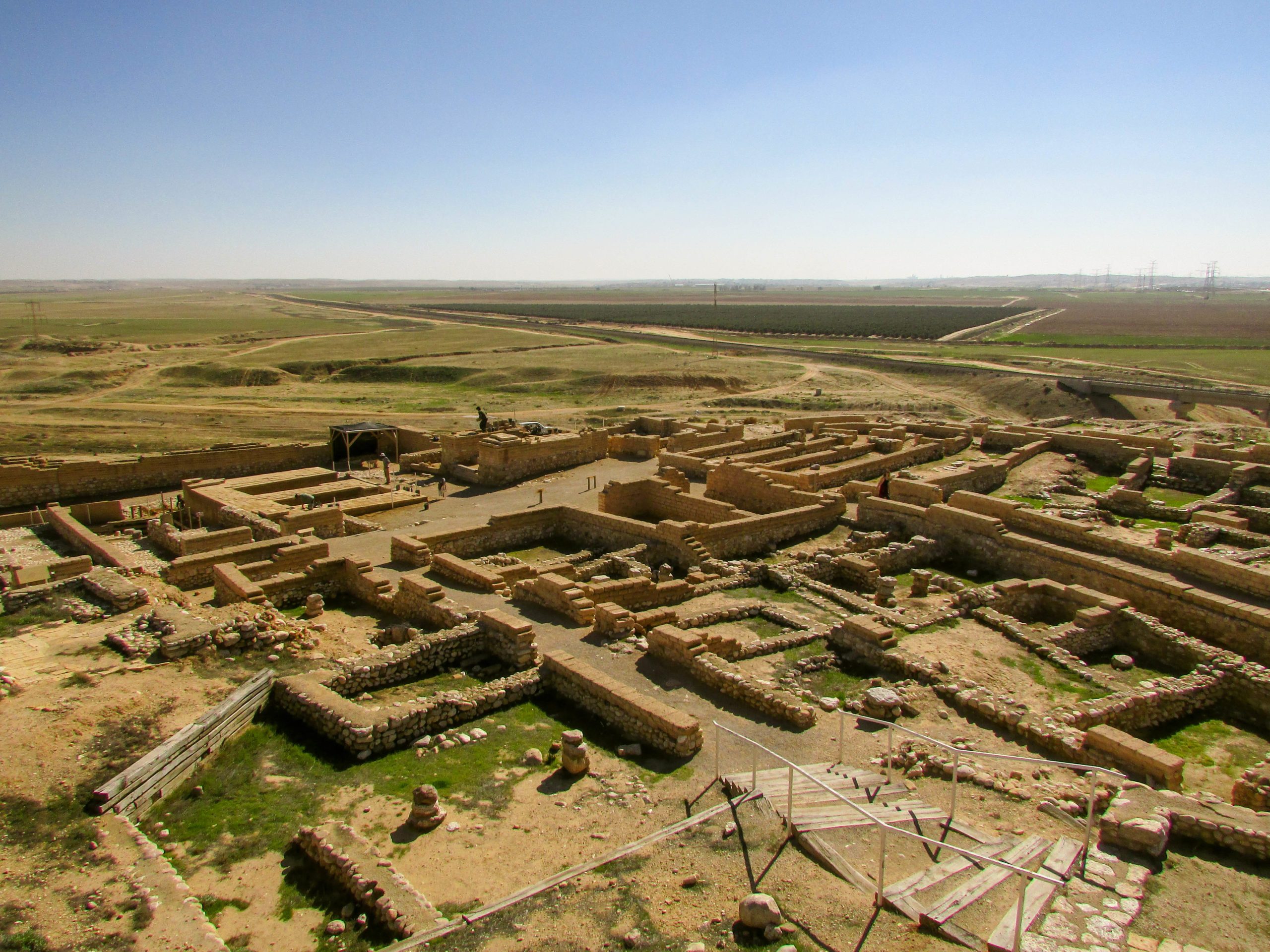
6. Beersheba: After he was sent away from Gerar, Abraham lived in Beersheba. It was here when Abraham was hundred years old that Sarah gave birth to the “Son of Promise”, Isaac whose name means "laughter".

 
Beersheba City (Ruins of the ancient city and the modern city nearby)

Moriah: While he was in Beersheba, God told Abraham to take his only son Isaac to one of the mountains in Moriah and to offer him as a sacrifice (Gen. 22:1-18). It is in this mountain that King Solomon later built the Temple of God.

Mount Moriah where the Temple of Jerusalem was built. The Temple was destroyed and now only the western wall remains.

When Abraham’s wife Sarah died, he bought the cave of Machpelah from Ephron the Hittite as the family burial place and buried his wife Sarah there (Gen. 23: 1-20). The Father of faith Abraham died at the age of 175, and was buried in the cave at Machpelah by his sons Isaac and Ishmael. 

The tomb of the Patriarchs at Machpelah where Abraham, Sarah, Isaac, Rebekah, Jacob and  Leah are buried


Bible Reference: Genesis 12 - 25 

Memory Verse: By faith Abraham obeyed when he was called to go ……………………….. not knowing where he was going. (Hebrews 11: 8 NKJV)


ASSESSMENT ACTIVITIES

Fill in the blanks:

1. Abraham travelled approximately ……………….. miles to Canaan

2. ………………………. was Abram’s first halting place recorded in the Bible.  

3. The name Isaac means “………………..”

4. Abraham’s bought the cave of ……………………… in Hebron as the family burial place.

Give short answers:

1. Who are the “Biblical Patriarchs”? 

2. What is special about the city “Ur of the Chaldees”? 

3. Why was Abraham expelled from Egypt? 

4. Who was Melchizedek? 

Answer in brief:

1. Why is Abraham’s journey, a “journey of faith”?