expr:class='"loading" + data:blog.mobileClass'>
Showing posts with label Lesson - 1. Show all posts

Monday, February 17, 2020

The Holy Bible - God's Priceless Treasure, Senior - I, Lesson -1

SENIOR

AGE GROUP: 14 - 15 YEARS

STANDARD (GRADE): IX & X

Permission is granted only for free distribution among Sunday School children.

No part of this document can be modified, sold or used for any commercial purpose.

LESSON – 1

THE HOLY BIBLE – GOD’S PRICELESS TREASURE 

What does the word “Bible” mean?
The Holy Bible, the most sacred book of the Christians is a collection of 66 books. The word "Bible" is not found in the Holy Bible. The Greek and Latin word "Bible" is translated as "Books”.  The Greek words Biblion (Luke 4:17; 2 Timothy 4:13) and Biblos (Luke 3:4) are both translated "Book" or "Books". (1)

Codex Sinaiticus, the oldest complete Holy Bible in the world written in the 4th century (Other older copies of the Holy Bible also exist in parts or as separate Books of the Bible).
Picture credit: British Library
Who wrote the Holy Bible?
The Holy Bible is very special because, it was written by more than 40 human authors who were inspired by a Divine Author.

The Divine Author: The Holy Bible is different from all other books because its author is God Himself. In 2 Timothy 3:16 we learn that "All Scripture is given by inspiration of God”- The human authors were just tools to record these words uttered by God. 
 

The human authors: 
The Holy Bible was written by more than forty different human authors who were inspired by the Holy Spirit of God over a period of about 1,500 years.
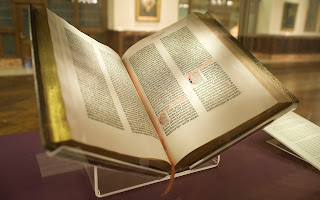
The world's first printed book - The Gutenberg Holy Bible. 
Picture credit: New York Public Library

The uniqueness of the human authors:
What makes the human authors of the Holy Bible unique is the unity in message that is seen in spite of their diverse backgrounds. The backgrounds of these authors are surprisingly diverse. Example: Joshua (an Army Commander), David (a King), Daniel (a Royal Official), Paul (a Scholar), Luke (a Physician), Peter (a Fisherman), and Nehemiah (a Cupbearer). 

The various books of the Holy Bible were also written in different places, such as the Wilderness (Moses), Palace (Daniel), Prison (Paul), in Exile (John). 
The Biblical writings were composed from three different continents (Africa, Asia, and Europe). The Bible was originally written in three different languages which was prevalent during those times when each of these books were written. The Old Testament was written in Hebrew and Aramaic, while the New Testament was written in Koine Greek language. In spite of all these differences, from the first verse of the first book to the last verse of the last book, all these books are written around a single theme “Eternal Life or God’s Redemption plan for mankind”.

OLD TESTAMENT

NEW TESTAMENT

Moses*: Pentateuch (Genesis to Deuteronomy) and Job

Joshua: The book of Joshua

      Samuel, Nathan and/or Gad: Judges, Ruth, 1 & 2 Samuel (Ref: I Chron 29:29,30) 

      Jeremiah: 1 Kings and 2 Kings 

      Ezra and Nehemiah: 1 & 2 Chronicles, Ezra and Nehemiah (Ref: Nehemiah 12:22,23) 

      MordecaiEsther  

      David, Asaph, sons of Korah, Heman, Ethan, Solomon and Moses and others: Psalms 

     Solomon: Proverbs,       Ecclesiastes and Song of Songs.

      IsaiahIsaiah 

      Jeremiah:  Jeremiah & Lamentations (Ref: II Chronicles 35:25) 

      EzekielEzekiel 

      DanielDaniel 

      Hosea: Hosea 

      Joel: Joel 

      AmosAmos 

      Obadiah: Obadiah 

      Jonah: Jonah 

      MicahMicah 

      Nahum: Nahum 

      Habakkuk: Habakkuk 

      Zephaniah: Zephaniah 

      Haggai: Haggai 

      Zechariah: Zechariah 

Malachi*: Malachi

      Matthew: Matthew

      John MarkMark 

      Luke: Luke and Acts (Ref: Luke 1:1-4; Acts 1:1,2) 

      John: John Gospel, 1, 2 & 3 John, Revelation 

      Paul: Romans, 1 & 2 Corinthians, Galatians, Ephesians, Philippians, Colossians, 1 & 2 Thessalonians, 1 & 2 Timothy, Titus and Philemon  

      Paul / unknown author: Hebrews 

      James, Jesus’ half-brother: James 

      Peter: 1 Peter and 2 Peter  

      Jude: Jude

We have to remember unless clearly mentioned in the Books of the Bible, the authors are attributed according to hints or clues given in the Book or Jewish tradition or other extra-Biblical sources. Sometimes the books start with the writing of the authors and conclusion is added later after the death of the authors (Example: The Book of Joshua)

The Greek Island of Patmos in the Aegean Sea where Apostle John wrote the Book of Revelations which was revealed to him during his exile here for the sake of the Gospel of Jesus Christ (Revelations 1:9)

The cave where Apostle John stayed during his exile in Patmos Island called the "Apocalypse Cave"

If men wrote it, then how can we say it is the Word of God?"  
We know that many men of God were moved by God to write the Holy Bible:  Moses, Paul, David etc.  If men wrote the Holy Bible, how can we say that it was written by God? According to 2 Peter 1:21, “All Scripture is given by the inspiration of God”. The Holy Spirit inspired these men in such a way that they recorded exactly what God wanted them to write. God the Divine Author used these men as tools to record these words. 

Example: Suppose a father wanted to convey an important message to his son. But he wrote it using different writing instruments (pencil, pen, sketch). The son would understand the exact information his father wanted to convey, since the message would not change even though the writing instruments were different. 

God had ordained men from different background men to be His writers, but the message uttered and inscribed by these men was the exact message that God intended for them to convey to humanity. Each book of the Holy Bible is different, since each of them wrote it according to their unique skills and abilities, but they communicated the message of God with complete precision. Fisherman Peter and a great scholar Paul did not have any difference in their messages. In spite of the fact that the Holy Bible was written over 15oo years, in different continents and settings, by more than 40 authors from diverse backgrounds, yet there is no discrepancy or disconnectedness in the message they wanted to convey.

Every book of the Holy Bible is woven around a single topic, "God's redemption plan for the salvation of mankind." It cannot be refuted that during ancient times, the more than 40 authors who were used by God to write the Holy Bible, could convey this single unique message, only because of the inspiration of the Divine Author. They did not have the privilege of the modern gadgets and communication facilities and they were also separated from each other by time and space. The Holy Bible is different from all other books because its author is God himself. 

The world's smallest Holy Bible taken to the moon by the Astronaut Edgar D. Mitchell in the year 1971. Picture credit: Bonhams.com

Qumran Caves and the Dead Sea Scrolls:

The Dead Sea Scrolls is considered to be one of the chief archaeological findings of the 20th century. The Dead sea scrolls were found in a place called Qumran caves. They consist of scroll copies of Biblical and apocryphal literature, and other writings. Some of the oldest known manuscripts of the Holy Bible were found here. Qumran became famous in 1947, when a shepherd boy from Palestine named Mohammad al-Theeb discovered scrolls in a cave, which were later christened the “Dead Sea Scrolls”. (2) 
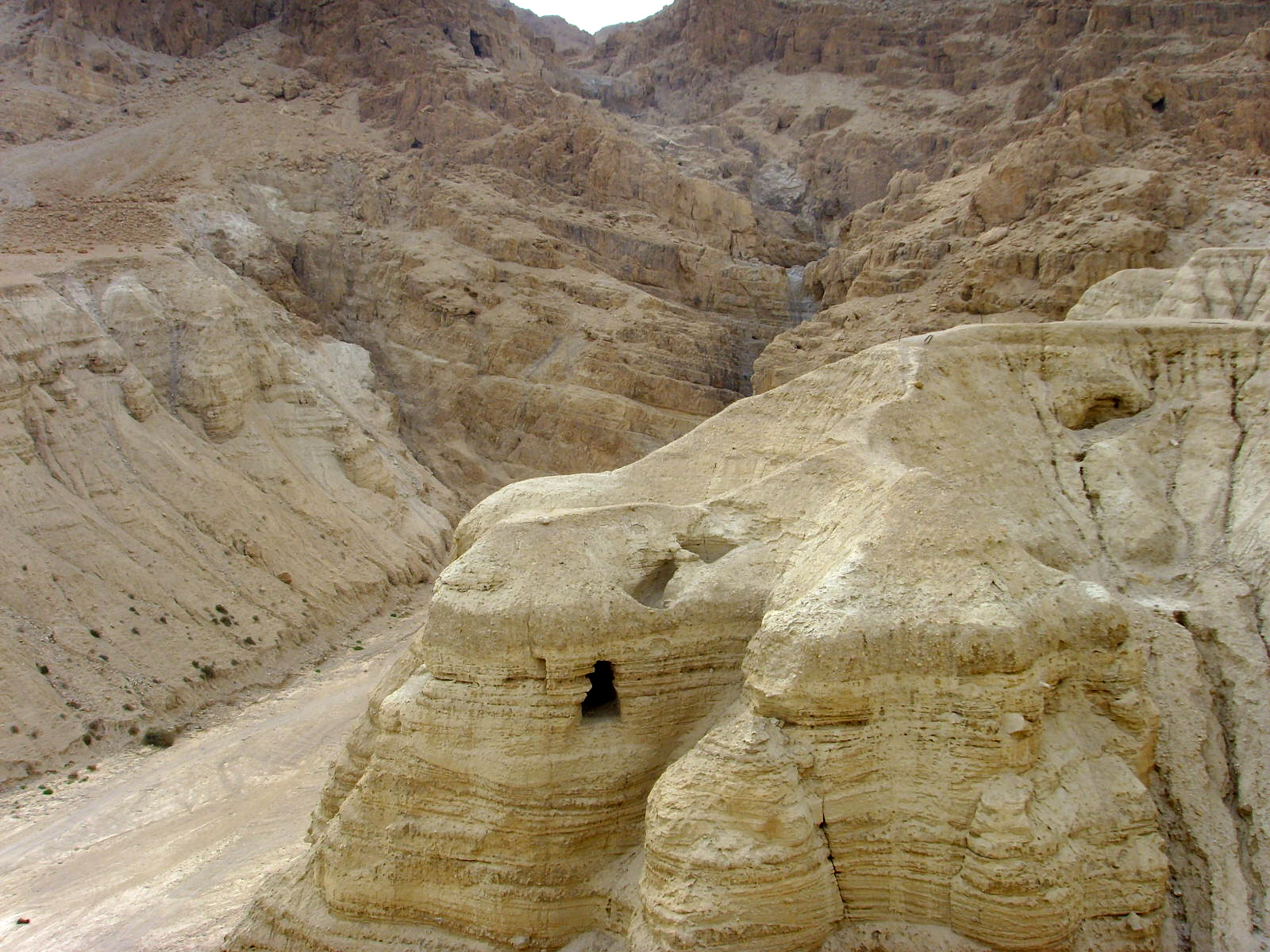
 

Qumran Caves 
(Picture credit: Effi Schweizer / Public Domain)

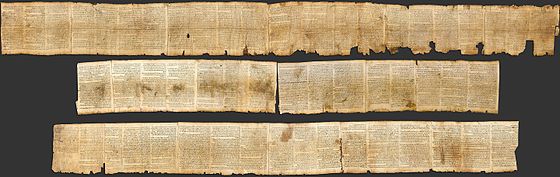
  The Book of Isaiah's Scroll (Ardon Bar Hama / Public Domain)

Khirbet Qumran is located on the western coast of the Dead Sea and around 20 km south of Jericho. These scrolls are thought to be from the years between 2nd century BC to 68 AD. They give us a glimpse into the life of the people of Biblical times and including the early years of Christianity. The excavation has revealed sophisticated building works, common facilities for community people, library etc. (2)

Memory Verse: All Scripture is given by inspiration of God, and is profitable for doctrine, for reproof, for correction, for instruction in righteousness, that the man of God may be complete, thoroughly equipped for every good work. (2 Timothy 3:16,17 NKJV)

Foot Notes:

Moses*: Moses is considered as the author of the first five books of the Holy Bible which are generally referred to as the Pentateuch which means “five scrolls”. Moses lived between 1500 and 1300 BC, though he recollects incidents such as the account of creation and the great flood which occurred before his birth. These earliest accounts were handed down from generation to generation through songs, narratives, and poetry (still we can find traces of these in folksongs, folktales and ancient poetry). During the ancient times, writing systems were not well developed and hence important events and occurrences were relayed from generation to generation through oral accounts with great emphasis on detail and accuracy. Some of the oldest writing systems began when symbols or pictures were engraved on stones or pressed on clay tablets. The Egyptians mastered this method and created the hieroglyphics, one of the earliest forms of writing. The Holy Bible tells us that Moses who was brought up as the Prince of Egypt by the Pharaoh's daughter was “Moses was learned in all the wisdom of the Egyptians” (Acts 7:22), so he would have known the writing systems of the Egyptians. We also read that God gave Moses “two tablets of the Testimony, the tablets of stone written with the finger of God” (Exodus 31:18). Hence it is possible that some of the earliest books of the Bible could have been written around 1400 BC. (3)

Malachi*: Prophet Malachi, wrote the last book of the Old Testament around 450 BC. There was a 500-year gap between the Old and the New Testaments when there was no divine inspiration and hence no writings of this period are available in the Holy Bible. It was during this time that Alexander the Great conquered much of the world and the Greek language was introduced to the Israelites. They began to use it so much in their day to day life that the Hebrew language was replaced by Greek and by another language, Aramaic, which was spoken in that area (2).

 Reference:

1.     Vine, W. E., Unger, M. F., White, W., & Vine, W. E. (1985). Vine's complete expository dictionary of Old and New Testament words. Nashville: Nelson.

2.     Qumran: Caves and Monastery of the Dead Sea Scrolls (Retrieved 5th August 2020 from https://whc.unesco.org/en/tentativelists/5707/)

3.     When was the Bible written? (Retrieved 5th August 2020 from https://www.biblica.com/resources/bible-faqs/when-was-the-bible-written/)

Click this link to get the next lesson - Senior Lesson 2 - The Holy Trinity or the Triune God


ASSESSMENT ACTIVITY

I.         Fill in the Blanks:

1. The Holy Bible was written by more than …………………….. human authors

2. The Biblical writings were composed from …………………. different continents

3. The Holy Bible was written over a period of about ……………….. years

4. The Dead sea scrolls were found in a place called ………….............


II.     Give short answers:

1. What does the word “Bible” mean?


2. Write about the backgrounds of some of the human authors of the Holy Bible?


3. Write about the languages in which the Holy Bible was written?


4. How do we know that the authors of the Holy Bible were inspired by God?


III. Give brief answers:

1. Write in brief about the Qumran caves and the Dead sea scrolls.


Monday, February 10, 2020

The Books of the Holy Bible, Intermediate - I, Lesson - 1

INTERMEDIATE

AGE: 12 - 13 YEARS

STANDARD/GRADE: VII & VIII

Permission is granted only for free distribution among Sunday School children.

No part of this document can be modified, sold or used for any commercial purpose.

LESSON – 1

THE BOOKS OF THE HOLY BIBLE

The Christian Protestant Holy Bible consists of 66 books that are divided into two major sections: The Old Testament and the New Testament. These 66 books are included in the Holy Bible based on a canon. The English word "canon" comes from the Greek word 'kanon' meaning 'rule' or 'measuring stick'. A biblical canon or canon of scripture* is a set of texts or books which the Christians consider as authoritative Scripture.  (Click this link to learn more about the Holy Bible)

Arrangement of the Holy Bible:

The books of the Holy Bible are arranged by type (law books, historical events, prophecies etc.), rather than in a chronological order i.e. their year of occurrence. Hence a book written much later is placed much ahead in the order and vice versa. Example: Book of Job written much earlier was placed along with books written much later. The Holy Bible is also a unique and exceptional literary work, since it is a mixture of various interesting forms of literature such as stories, poems, allegories and many more. 

The Old Testament:

The Old Testament of the Holy Bible was originally written in Hebrew Language and it is the equivalent to the Hebrew Bible (Tanakh). It was written from approximately 1600 BC to 400 BC. All the books of the Old Testament were written before the birth of Christ (BC). 

The Old Testament consists of 39 books which are grouped into 5 categories: 

1. The Pentateuch (5 books of Moses)

2. Books of History

3. Books of Wisdom & Poetry

4. Major Prophets (because of the large size of the prophetic books) 

5. Minor Prophets (because of the small size of the books) 

Sefer Torah Scroll - A handwritten copy of the Torah Photo credit: Lawrie Cate

Old Testament & Jewish Scriptures: Although the content of the Old Testament and the Jewish Scriptures (Tanakh) are the same, they differ in their organization. The Jewish Scriptures are organized into three parts: 1. The Law (Torah) 2. The Prophets (Nevi’im) 3. The Writings (Ketuvim). The Jewish Scriptures is also called the Tanak, taking the first letter of these sections. 


S. No.

Divisions

Books

1.

Pentateuch (5 books)

Genesis, Exodus, Leviticus, Numbers, and Deuteronomy

2.

The Books of History (12 books)

Joshua, Judges, Ruth, 1 & 2 Samuel, 1 & 2 Kings, 1 & 2 Chronicles, Ezra, Nehemiah, and Esther.

3.

Books of Wisdom & Poetry

Job, Psalms, Proverbs, Ecclesiastes, and Song of Solomon.

4.

Major Prophets

Isaiah, Jeremiah, Lamentations, Ezekiel, and Daniel.

5.

Minor Prophets

Hosea, Joel, Amos, Obadiah, Jonah, Micah, Nahum, Habakkuk, Zephaniah, Haggai, Zechariah, and Malachi

The New Testament:

The New Testament of the Holy Bible only exists in Christianity. It was originally written in Greek, the common language of the world at that time. The New Testament was written during the last half of the first century A.D. The New Testament consists of 27 books. They are grouped into 5 categories: 

1. The Gospels  

2. Church History  

3. Pauline Epistles

4.  General Epistles   

5.  Apocalyptic (End Time Prophesy)

S. No.

Divisions

Books

1.

The Gospels

Matthew, Mark, Luke, and John.

2.

Church History

Acts of the Apostles

3.

Pauline Epistles

Romans, 1 & 2 Corinthians, Galatians, Ephesians, Philippians, Colossians, 1 & 2 Thessalonians, 1 & 2 Timothy, Titus, and Philemon.

4.

General Epistles

Hebrews, James, 1 & 2 Peter, 1,2 & 3 John, and Jude.

5.

Apocalyptic

Revelation

The Message of the Old Testament

The books of the Old Testament tell us about

         Creation of the universe, Fall of mankind or how man lost eternal life

          God's salvation plan & how satan tried to prevent God's salvation plan

         How the world was prepared for the arrival of the Messiah.

The Message of the New Testament:

The books of the New Testament tell us about

              Birth of the Messiah, Jesus Christ

               Fulfillment of God's salvation plan through the atoning death of Jesus

               Receiving eternal life through belief in Jesus Christ

               End of the ages, Second Coming of Jesus Christ & Eternity with God.

The Authenticity of the Holy Bible: 

Although many people have tried to discredit the authenticity of the Holy Bible, it has withstood the test of time. Thousands of copies of the Scriptures were made by hand before the invention of the printing press. There are 24,000 manuscripts still available including 5300 Greek manuscripts from the New Testament alone. Hence, the Holy Bible has better preserved writings than those the of most famous ancient authors such as Homer, Plato and Aristotle, which are accepted as authentic and read widely. Better preserved and a greater number of copies of manuscripts of the Holy Bible is available than the religious books of other religions which originated much later. (1)

Accuracy in Translation of the Holy Bible:

The Holy Bible was carried to many countries and continents and translated into many languages that were entirely different from the original languages in which the Holy Bible was written. Some of these languages did not even have the necessary words in their linguistic repertoire for translation. Apart from the discrepancies that arose from such cultural differences, the message of the Holy Bible has been accurately conveyed through all the translations of the Holy Bible. God's word, the Holy Bible has been remarkably preserved and translated and gives hope and life to millions of people around the world.

The Holy Bible is God's living word. It is active and powerful. Although the main theme of the Holy Bible is eternal life with God, the books of the Holy Bible cover every aspect of human life and is sufficient for every human need and concern. 

Memory Verse: For as the rain comes down, and the snow ………………. And it shall prosper in the thing for which I sent it (Isaiah 55:10,11 NKJV).

Footnotes:   

The canon of the New Testament:  During the first century, the Church began to grow and expand. The Apostles who lived with Jesus, their disciples and  other scholars recorded the events surrounding the birth of Jesus Christ, his life on earth, his death, the growth and expansion of Church and also about the ministry of the Apostles. Many of these books were read along with other Old Testament books such as Psalms. The epistles (letters) written by the Apostles to these Churches were also read when the early Christians gathered for worship. We can read about it in Bible verses such as Colossians 4:16. Since many such books started to be circulated among the Churches, there arose a need to authenticate these books. Hence, to decide whether a book measured up to the standard of the Holy Scriptures four main criteria were used by the early church fathers. This is called the Biblical canon. The English word "canon" comes from the Greek word 'kanon' meaning 'rule' or 'measuring stick'.

Some of the main criteria were 

Apostolic Origin: The books must be attributed to and/or based on the preaching/teaching of the first-generation apostles (apostles who lived with Jesus) or their closest companies. 

Universal Acceptance: The books must be acknowledged by all major Christian communities in the Mediterranean World (around the fourth century). 

Liturgical Use: The books must be read publicly along with the Old Testament when the early Christians gathered for the Lord's supper (their weekly worship services).

Consistent Message: The books must contain theological ideas compatible with other accepted Christian writings (including the divinity and humanity of Jesus Christ. The books that satisfied these criteria were included as part of the Holy Bible. (3)

The other books were considered non-canonical or apocryphal books and left out of the Holy Bible.  The word “apocrypha” comes from the Greek word meaning "hidden" or "secret." Apocrypha are works usually written of unknown authorship or of doubtful origin, hence these books are not held equal to the Sacred Scriptures, and they were not included in the Christian Protestant Holy Bible. The canon of the New Testament was well established by the 5th century AD.

Reference:

1.     Slick M. (2008, October 12). Manuscript evidence for superior New Testament Reliability (Retrieved 5th August 2020 from https://carm.org/manuscript-evidence)

2.  Felix Just S. J., The New Testament Canon (Retrieved 5th August 2020 from http://catholic-resources.org/Bible/NT_Canon.htm#Stages)

 ASSESSMENT ACTIVITIES

Fill in the blanks:

1. The 66 books are included in the Holy Bible based on a …………………..

2. All the books of the …….…………………. were written before the birth of Christ. 

3. The Jewish Scriptures is also called the …………………..

4. …………………. Greek manuscripts from the New Testament are available.

Give short answers:

1. How are the books of the Holy Bible arranged? 

2. What are the five main categories of the Old Testament books? 

3. How do the Old Testament and the Jewish Scriptures differ? 

4. What is the collective message of the New Testament books? 

Answer in brief:

1. How do we know the authenticity of the Holy Bible?